Honda middleweight inline-four · 649 cc · 2014 → today
CBR650F vs CBR650R
Same 649 cc four, same steel diamond frame, same 810 mm seat. The R is not a restyled F — it is the same engine tuned to work 1,000 rpm higher, hung in a sharper chassis with better forks and a rider moved forward over the front wheel.
The single difference that explains all the others
Where the engine does its work
Read it left to right: the R's whole working band slides right. Peak torque moves up 1,500 rpm, peak power up 1,000 rpm. You get +5 PS — but you have to rev for it. Below 6,000 rpm the F is the marginally easier bike to ride lazily.
What actually changed in 2019
Five real differences
Conventional fork → USD
F: 41 mm right-way-up telescopic (Showa SDBV from 2017). R: 41 mm Showa SFF-BP inverted fork — stiffer, lighter, far more feedback on turn-in.
Smaller discs, better calipers
F: 320 mm twin discs, 2-piston axial calipers. R: 310 mm twin discs but 4-piston radial-mount — less rotating mass, more bite and feel.
Sit-on → lean-over
F: bars above the top yoke, upright, tourer-friendly. R: clip-ons below the yoke, pegs raised and set back. Same 810 mm seat, very different wrists.
ABS only → HSTC + TFT
F: ABS, LCD dash, no traction control. R: HSTC traction control, assist/slipper clutch, and from 2024 a 5-inch TFT with RoadSync and optional E-Clutch.
Lighter bike, smaller tank
F: 211 kg wet, 17.3 L tank — the long-haul advantage. R: 207 kg wet (211 kg with E-Clutch), 15.4 L. Better power-to-weight, shorter legs.
Used-only vs current
F ran 2014–2018 and is a used-market bike now. R has been in production since 2019 and was refreshed in 2024 — parts, warranty and finance all still live.
Side by side
Full specification
| Specification | CBR650F (2017) | CBR650R (2024+) |
|---|---|---|
| Engine | 649 cc liquid-cooled DOHC inline-4, 16v | 649 cc liquid-cooled DOHC inline-4, 16v |
| Bore × stroke | 67.0 × 46.0 mm | 67.0 × 46.0 mm |
| Compression | 11.4 : 1 | 11.6 : 1 |
| Max power | 90 PS (67 kW) @ 11,000 rpm | 95 PS (70 kW) @ 12,000 rpm |
| Max torque | 64 Nm @ 8,000 rpm | 63 Nm @ 9,500 rpm |
| Gearbox | 6-speed, 525 chain | 6-speed, 525 chain |
| Clutch | Wet multiplate | Assist/slipper · E-Clutch optional |
| Frame | Steel diamond | Steel diamond |
| Front suspension | 41 mm conventional telescopic | 41 mm Showa SFF-BP inverted |
| Rear suspension | Monoshock, preload adjustable | Monoshock, preload adjustable |
| Front brakes | 2 × 320 mm, 2-piston axial | 2 × 310 mm, 4-piston radial |
| Rear brake | 240 mm single-piston | 240 mm single-piston |
| Rider aids | ABS | ABS + HSTC traction control |
| Instruments | LCD | 5-inch TFT, Honda RoadSync |
| Tyres | 120/70-17 · 180/55-17 | 120/70-17 · 180/55-17 |
| Wheelbase | 1,450 mm | 1,450 mm |
| Rake / trail | 25.5° / 101 mm | 25.5° / 101 mm |
| Seat height | 810 mm | 810 mm |
| Kerb weight | 211 kg | 207 kg (211 kg E-Clutch) |
| Fuel tank | 17.3 L | 15.4 L |
| Power-to-weight | 0.43 PS/kg | 0.46 PS/kg |
| Production | 2014 – 2018 | 2019 – current |
Coloured rows = genuine differences. Grey rows = carried over unchanged. Figures are Euro-spec; India-spec output has historically been detuned.
Choosing
Which one, for what
Take the F if
- You cover distance — 17.3 L and upright bars beat the R on a 400 km day
- You want inline-four smoothness at commuting revs
- Budget matters; it is used-market money for the same engine architecture
- Wrists and neck are the limiting factor, not lap times
Take the R if
- You ride twisties and actually use 9,000–12,000 rpm
- You want the USD fork and radial brakes — the real handling upgrade
- You want traction control, TFT, warranty and a live parts chain
- E-Clutch appeals for stop-go traffic without giving up manual shifting
Spaced retrieval
Recall drill
How the decision actually got made
The conversation, in order
What is the difference between CBR650F and CBR650R?
Same 649 cc four, same steel diamond frame, same 810 mm seat, same wheelbase and geometry. The R is the same engine tuned to work 1,000 rpm higher, hung in a sharper chassis: inverted Showa fork, radial four-piston brakes, clip-ons below the yoke, traction control, TFT. The F carries a bigger tank and a friendlier riding position.
What difference does compression 11.4 vs 11.6 make?
On its own, almost none — roughly 0.3% thermal efficiency, about half a horsepower. It is a side effect of reshaping the combustion chamber for high-rpm breathing, and a compensation for the bottom-end torque lost in that process.
Where you feel it: fuel quality. Higher compression means less knock margin. Rural pumps matter more on the R.
Which one wheelies more easily?
The R, marginally — lighter, more power, slipper clutch. But neither is a natural wheelie bike. A 1,450 mm wheelbase and smooth inline-four delivery mean both are clutch-up bikes, not power-up bikes. The XPulse does it with a fraction of the effort.
Which is less tiring over 200 km?
The F, clearly. Bars above the yoke instead of clip-ons below it, 17.3 L against 15.4 L, and a more open knee angle. The engine is equally smooth on both.
The honest caveat given at the time: both are sport bikes. No cruise control, no adjustable screen, weight on the wrists either way. If long rides are the norm rather than the exception, neither is the right shape of motorcycle.
Which is easier to live with?
The R. The F stopped production in 2018 — panels, levers and radiators mean waiting on order, dealers consult manuals, resale is slow, no warranty is possible. Service cost is identical: both are 16-valve fours, and valve-clearance work is the expensive item on either.
The R being considered is without E-Clutch.
Better on balance. 4 kg lighter (207 vs 211 kg), full clutch modulation at walking pace, fewer components to fail, and roughly ₹40,000 less. What is given up is the quickshifter — every shift is a lever pull on an engine that lives at 12,000 rpm. Fork, brakes, HSTC and TFT are unchanged.
Registration certificates — both bikes are used.
R · HR05U7666 — owner serial 01, manufactured 02/2025, registered 26-03-2025, hypothecation blank, Karnal registration, valid to 2040. Clean same-state transfer, no lien, no NOC.
F · DL3SG0777 — owner serial 04, manufactured 11-2015, BS-IV, Delhi registration expiring January 2031, card issued September 2025. The current owner took possession under a year ago and is already selling.
So which is the better investment?
Neither. Both are consumption goods that lose value while being enjoyed. An existing NCD at 9.21% outperforms either by definition — a motorcycle has no yield, only cost.
Rephrased as which destroys less capital: the R. The first owner absorbed the 20–25% first-year drop; the curve flattens from here. The F's downside is unbounded relative to its price — one valve job or one unobtainable fairing panel can equal a third of the purchase.
The R shows 4,500 km. Gentle handling, occasional conscious highway pace. Knee and posture issues. 500 km stretches wanted.
On the odometer — correct. 4,500 km is barely run in, and the first valve inspection sits far ahead. But be clear-eyed: the interval is measured in kilometres, not in how kindly you ride. Gentle handling delays nothing. It arrives on schedule, and on a 16-valve four it is not a small bill.
On the body — this is the part that cannot be negotiated with. Clip-ons below the yoke, raised pegs, no back support. Knee and posture issues do not improve with exposure to a sport bike. They get louder. A 500 km stretch on the R is not a comfort question, it is an endurance question.
The road not yet considered
Super Meteor 650
Royal Enfield · 648 cc parallel twin · ₹4.06–4.40 lakh ex-showroom, new
Consider the cruiser
Every honest answer in this document has pointed the same direction, and none of them were looking for a cruiser. The F won on posture and lost on paperwork. The R won on everything except the one thing that was never up for negotiation — the body that has to sit on it for 500 km. When the evidence keeps circling a door you haven't opened, it is worth opening.
What it solves. Feet forward, wide bars, 740 mm seat. The knee angle opens instead of folding. Wrists carry nothing. Peak torque arrives at 5,650 rpm — you never need to visit 12,000 rpm to make progress, so the highway pace you described happens without effort or anxiety. Two valves per cylinder instead of sixteen: service is simpler, cheaper, and available at any Royal Enfield workshop in Haryana rather than a BigWing in Karnal or Chandigarh.
And it costs less, new. A brand-new Astral at ₹4.06 lakh ex-showroom against a used first-owner R. Full warranty, zero transfer paperwork, registration valid fifteen years from your name.
What it will cost you — said plainly
- 241 kg. That is 87 kg more than the XPulse. Every U-turn, every parking manoeuvre, every gate on a Pehowa track. The low seat helps, but weight is weight.
- 135 mm ground clearance, 1,500 mm wheelbase. Speed breakers and broken village roads need real care. This bike does not go where the XPulse goes, and it never will.
- The rear suspension is firm — 101 mm of travel and a widely reported complaint. On Indian roads your spine takes what the shocks don't.
- The base bike is not a 500 km bike. Feet-forward with no back support loads the lower back and tailbone. Without a touring screen and backrest, wind hits your chest square at 100 km/h and there is nothing to brace against. Treat those accessories as part of the purchase price, not extras.
- 47 PS against 95 PS. Overtaking is deliberate, not instant. Above 120 km/h it buzzes. If the sound of a Honda four at 12,000 rpm is something you actually want, no cruiser will replace it, and you will resent this bike for not being one.
- Royal Enfield build variance is real. Inspect the specific unit. It is not a Honda.
So here is the whole thing, without decoration: the R is the finer machine and the Super Meteor is the better fit. One rewards a body you don't have; the other accommodates the body you do. The R will ask you to fold yourself into its shape for fifteen years and will be beautiful the whole time. The cruiser asks nothing — it simply sits low, pulls from 2,500 rpm, and lets your knees stay open across the Grand Trunk Road at dusk.
You already own the bike that goes anywhere. What is missing is the one that goes far, comfortably, and stays cheap to keep. Ride both before deciding — the Super Meteor's weight at standstill is the single thing that will settle it, and no specification sheet can tell you how that feels. Ten minutes in a dealership car park will.
The option already parked outside
XPulse 210
Hero MotoCorp · 210 cc single · already owned · ₹0 to acquire
Buy nothing
There is a fourth answer, and it has been standing in the shade the whole time. Every bike above asks you to open a new expense head — a purchase, an insurance line, a service account, a depreciation curve running quietly against you for fifteen years. The XPulse asks for none of that. It is already yours, already registered, already paid for.
What it already does well. 24.6 PS and 20.7 Nm is modest on paper and entirely sufficient on a Haryana state highway. 220 mm of ground clearance and 168 kg mean the Pehowa tracks, the field bunds, the unmetalled approach to a polyhouse — all of it is ordinary. Upright bars, centre-set pegs, a long flat seat: the posture is the one your knees actually want, closer to the cruiser's geometry than to the R's. 40 kmpl against the R's 20. And it still carries a 5-year / 70,000 km warranty.
Rough annual burn — depreciation plus fuel, service, insurance and tyres. Indicative, not quoted.
Where it genuinely falls short — no softening. A 210 cc single at 100 km/h is working, not loafing; 500 km in a day is possible but it is a longer, busier day than on either 650. The seat is narrow and softly padded, and riders report it becoming the limiting factor around the two-to-three hour mark. The 13 L tank means more stops. Tube tyres mean a puncture on the Kurukshetra–Narkanda road is a real inconvenience, not a plug and a pump.
The cheap path that closes most of the gap
- A proper touring seat or gel insert — the single highest-value change. Fixes the actual limiter.
- A taller screen — removes the chest-buffeting that makes 100 km/h tiring rather than fast.
- Bar risers — a small angle change that keeps the lower back neutral over long hours.
- Tubeless conversion or a good repair kit — turns a roadside crisis into a twenty-minute stop.
- Soft luggage — weight off your shoulders and onto the frame, where it belongs.
Said as a brother would say it: you do not have a motorcycle problem. You have a seat, a screen and a set of bar risers between you and the ride you are describing. The R is a fine machine your knees will argue with. The Super Meteor is a sensible machine that adds ₹4 lakh and 87 kg to your life. The XPulse is already sitting there, already suits your posture, already goes where your land is, and costs a fraction of either to keep alive.
Spend ₹25,000 on the bike you own. Ride Kurukshetra to Narkanda on it once more with a better seat under you. If after that ride you still want the cruiser — you will know it for a real want, not a restlessness dressed up as a decision. And the money will still be in the NCD, compounding quietly, waiting for you to be sure.
Papers and proof
Evidence locker
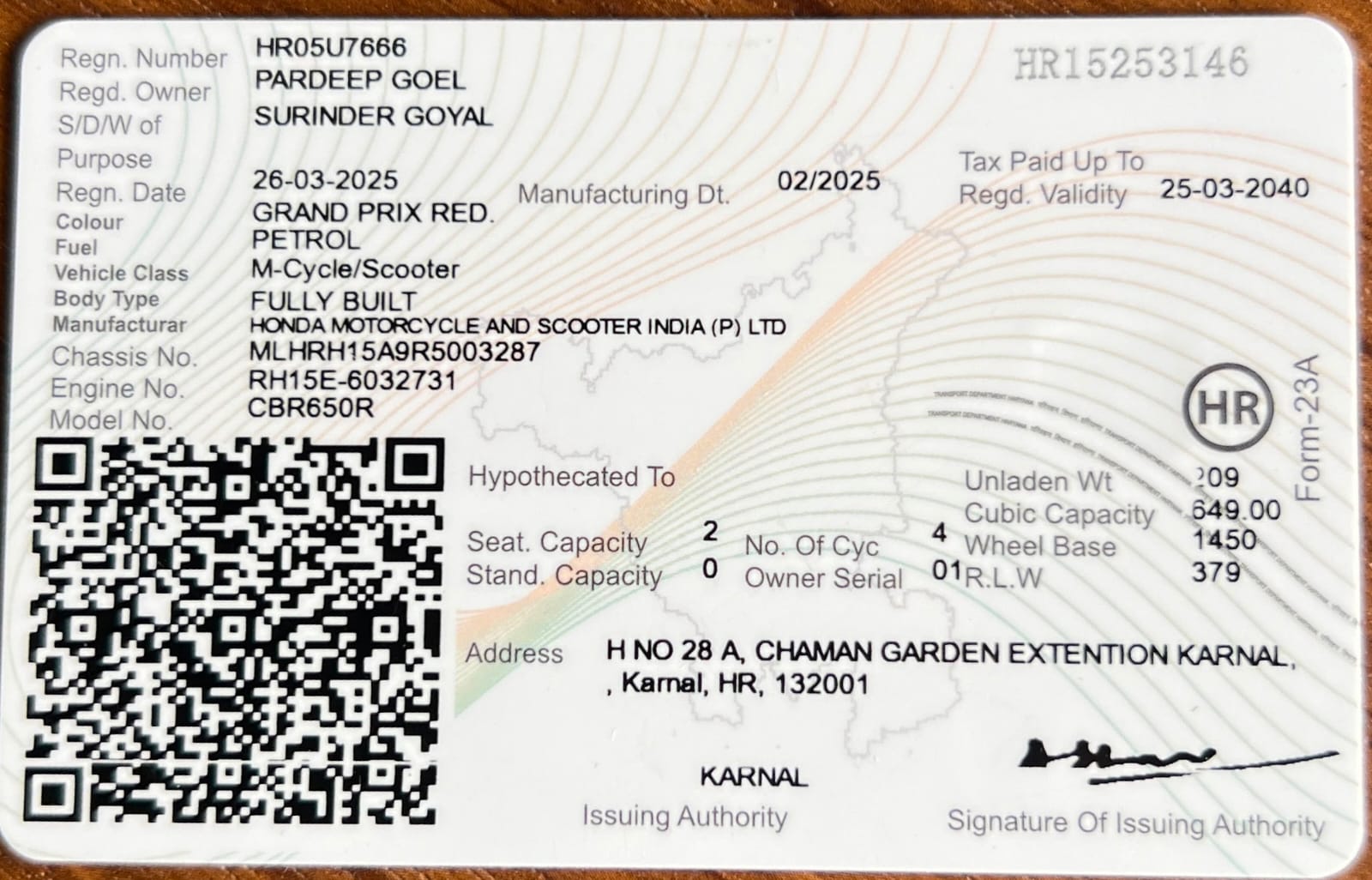
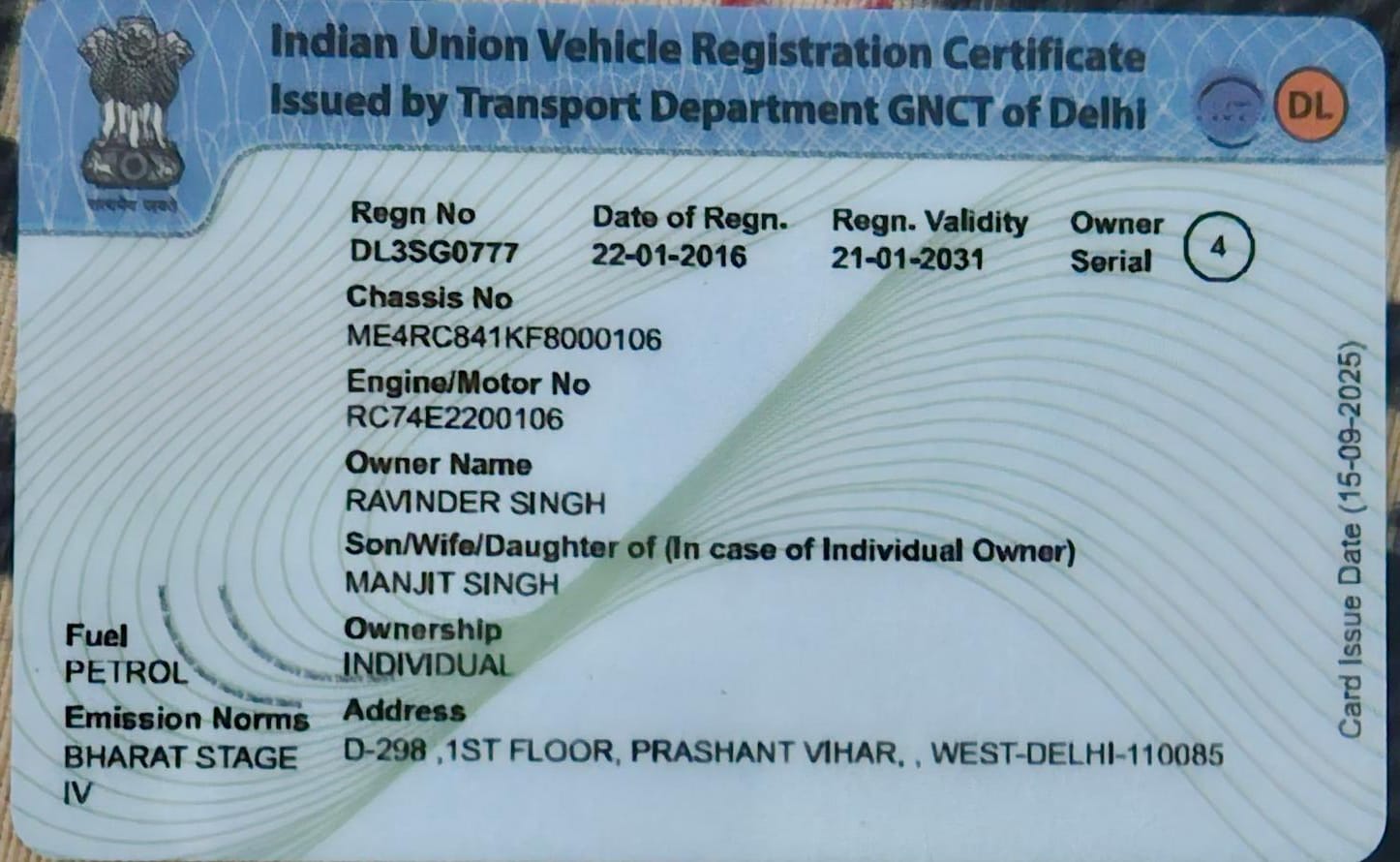
Session-only. Files load into this page in your browser and are never uploaded anywhere. They clear when you close the tab — this document keeps no storage by design. To make them permanent, save the files beside this HTML and replace a slot's <label class="drop">…</label> with <img src="rc-r.jpg"> or <video src="walkaround.mp4" controls></video>.
What the walk-around must actually show
- Chassis and engine stamps, in focus. Must read
MLHRH15A9R5003287andRH15E-6032731. Any grinding, restamping or filler around them ends the conversation. - A genuinely cold start. Insist the engine has not been warmed before you arrive. Listen for cam-chain rattle in the first ten seconds; watch the exhaust for smoke.
- The right-side clutch cover. Confirm there is no E-Clutch actuator bulge — this is the variant you are paying less for.
- Fork stanchions, both legs, full length. Pitting or weeping oil on a 4,500 km bike means it has been dropped or stored badly.
- Fairing bolt heads. Burred or rounded screws mean panels have been off. Ask why.
- Bar ends, lever tips, exhaust can edge, peg feelers. The four places a drop always leaves a mark.
- Radiator core, straight on. Bent fins or stone damage are cheap to see and expensive to fix.
- Chain, sprockets and tyres. At 4,500 km all four should look close to new. Check the DOT date code against the 02/2025 build — original rubber should match.
- The TFT, powered up. Odometer reading, any warning icons, service reminder status, and the trip menus working.
- Steering lock to lock, front wheel off the ground. Notchiness means head bearings.
A video is a filter, not a verdict. Use it to decide whether the trip to Karnal is worth making. Nothing gets paid until you have started it cold yourself, matched the numbers by hand, and pulled the VAHAN record on your own phone.